A capacitor of capacitance C is charged to a potential V. Now it is connected to a battery of e.m.f E as shown in the figure:
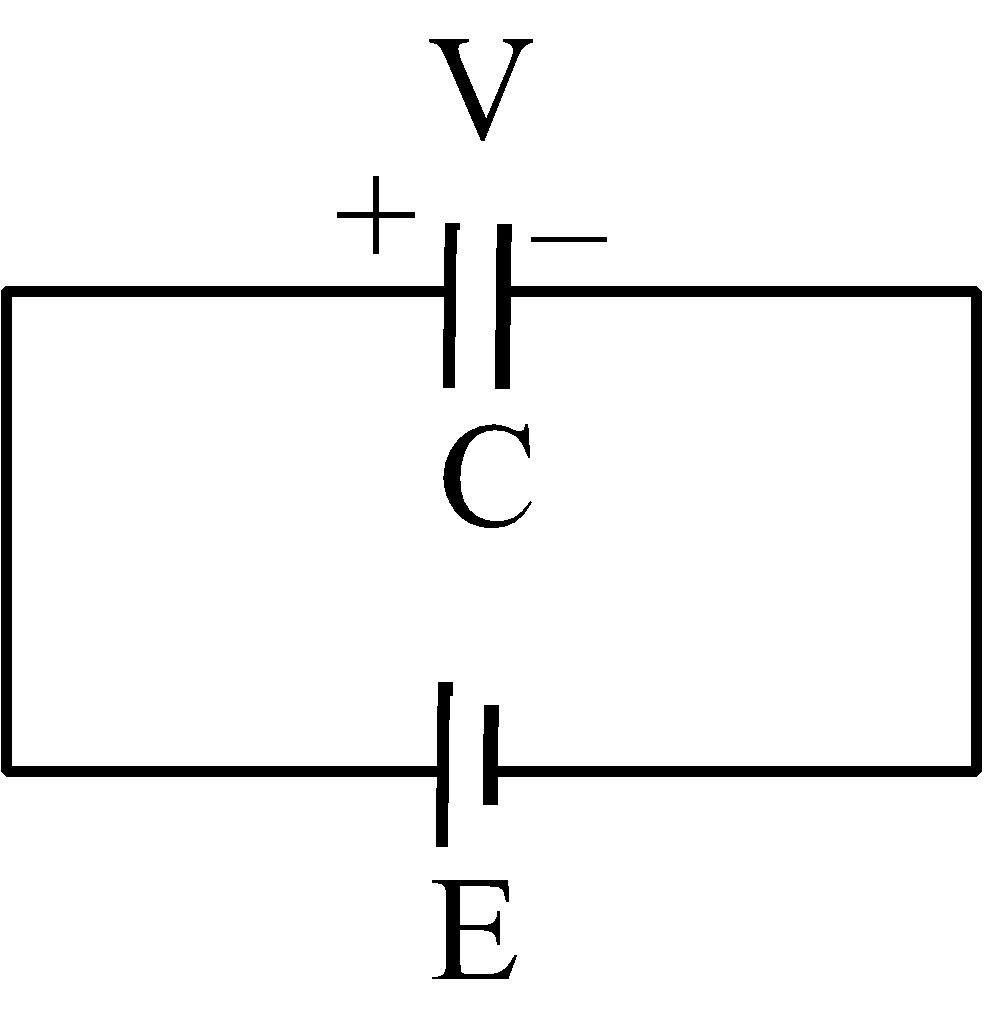
Column-I | Column-II |
(i) If V = E, then | [A] non-zero charge is supplied by the +ve terminal of battery to+ve plate of capacitor |
(ii) If V > E | [B] Zero charge is supplied by + ve terminal of battery to +ve plate of capacitor |
(iii) If V < E, then | [C] non-zero thermal energy will be dissipated in the circuit |
(iv) If V E, then | [D] outer surfaces of the plates of capacitor have zero charge |

Text Solution
Verified by ExpertsCHECK THE SOLUTION.
Ans.
(i) [B],[D]
(ii) [C],[D]
(iii) [A],[C],[D]
(iv) [A],[C],[D]
Sol.
For A: As potential difference across the apacitor is same as that of e.m.f of battery, no charge will be supplied by battery and hence work done by battery = 0
U i = U f so Δ H = 0
In all cases, zero charge appears on outer surfaces of the plates of capacitor.
For B: As V > E, so capacitor charges the battery and hence thermal energy will be developed in circuit.
For C: As V < E so battery performs some work on the capacitor.
For D: Combination of B and C.
Prepare Smarter with CGP Edu
Get practice questions, solutions, and test series in one place.
Write a Review
Share your experience with this question and solution.
Commentary
Send your comment, doubt, correction, or feedback to admin.
Similar Questions
Explore conceptually related problems